


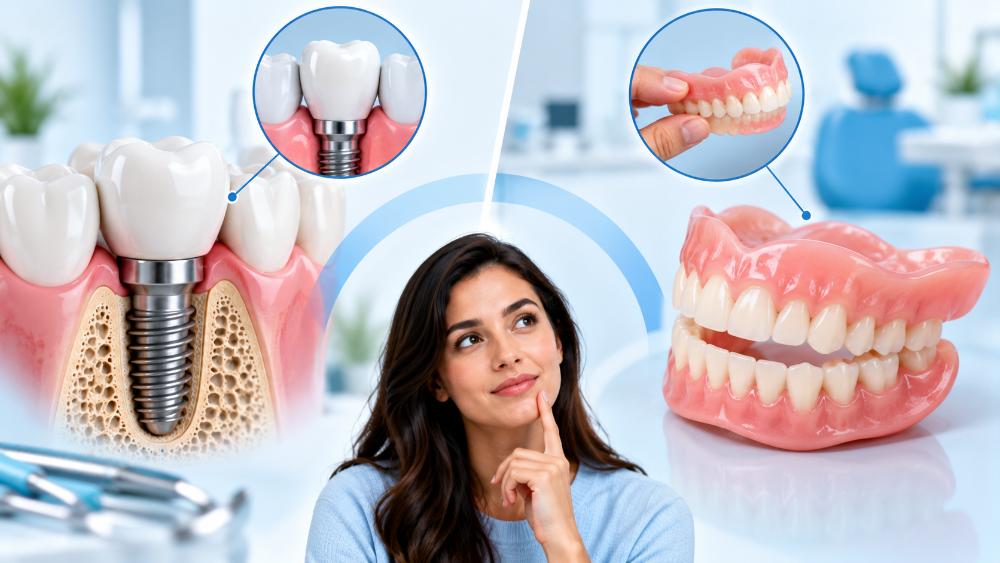
Losing one or more teeth can affect much more than your smile. Missing teeth may make it difficult to chew food, speak clearly and feel confident in social situations. Fortunately, modern dentistry offers several options for replacing missing teeth. Two of the most commonly considered choices are dental implants and dentures.
While both can restore the appearance and function of your teeth, they work in very different ways. Understanding the advantages, limitations and suitability of each option can help you have a more informed discussion with your dentist.
What Are Dental Implants?
Dental implants are artificial tooth roots designed to support replacement teeth. They are typically made from biocompatible materials and are placed into the jawbone through a surgical procedure. Once the implant has integrated with the surrounding bone, it can support a crown, bridge or implant-supported denture.
One of the biggest advantages of dental implants is that they are designed to provide a stable, fixed foundation. Unlike removable dentures, implants do not normally need to be taken out while eating or speaking.
Dental implants can be used to replace a single missing tooth, several teeth or, in appropriate cases, an entire arch of teeth.
What Are Dentures?
Dentures are removable dental appliances designed to replace missing teeth and surrounding oral tissues. Depending on the patient’s needs, they may replace several teeth or an entire set of teeth.
Complete dentures are used when all teeth in an arch are missing, while partial dentures can replace multiple missing teeth when some natural teeth remain.
Dentures are generally less invasive than implants because they do not require implant surgery. They can also provide an effective way to restore chewing ability and the appearance of a natural-looking smile.
Dental Implants vs. Dentures: Key Differences
Stability and Comfort
Dental implants are anchored into the jawbone, which provides greater stability during everyday activities such as chewing and speaking. Once treatment is completed and the tissues have healed, implants can feel more like natural teeth.
Traditional dentures rest on the gums and may move slightly, particularly when eating or speaking. Properly fitted dentures can be comfortable, but some people may require an adjustment period.
Appearance
Both implants and dentures can be designed to look natural. Dental implants are generally considered highly natural-looking because the replacement tooth is supported from within the mouth.
Modern dentures can also provide an attractive smile and can be customised to match the patient’s facial features and appearance.
Bone Health
When a natural tooth is lost, the jawbone in that area may gradually shrink because it no longer receives stimulation from the tooth root. Dental implants can provide stimulation to the surrounding bone because they are placed within the jaw.
Traditional dentures do not replace the natural tooth root, so they do not provide the same type of stimulation to the jawbone.
Eating and Chewing
Dental implants provide a stable foundation for replacement teeth, which can make eating a wide range of foods easier for many patients.
Dentures can also restore chewing function, although certain hard, sticky or chewy foods may be more challenging. Patients may need some time to adapt to eating with dentures.
Maintenance
Dental implants should be cared for much like natural teeth, with regular brushing, cleaning between teeth and professional dental check-ups. Depending on the type of implant restoration, special cleaning methods may also be recommended.
Dentures need to be removed and cleaned regularly. They may also need to be soaked as recommended by the dentist or denture-care instructions. Regular dental visits remain important even when all natural teeth have been replaced.
Cost and Treatment Time
The cost of dental implants and dentures varies significantly depending on the number of teeth being replaced, the materials used, the complexity of treatment and the dental clinic.
Dentures generally have a lower initial cost and can often be provided without the surgical procedures associated with implants. Dental implant treatment usually involves a longer treatment process because the implant needs time to integrate with the jawbone before the final restoration is placed.
In some cases, additional procedures such as bone grafting may be recommended before implant placement.
Who May Be Suitable for Dental Implants?
Dental implants may be an option for people with adequate jawbone support and healthy oral tissues. Overall health, smoking or tobacco use, oral hygiene and certain medical conditions can also influence implant treatment planning.
A detailed dental examination, often including imaging, is necessary to determine whether implants are appropriate.
Who May Benefit From Dentures?
Dentures may be suitable for people who have lost several or all of their teeth and want a removable replacement option. They can also be considered when implant treatment is not appropriate or when a patient prefers a non-surgical solution.
For some individuals, implant-supported dentures may offer a middle ground by combining removable prosthetic teeth with the added stability provided by implants.
Which Option Is Right for You?
There is no single solution that is best for everyone. Your choice may depend on the number of missing teeth, jawbone condition, oral health, lifestyle, budget, treatment preferences and overall health.
Dental implants may be preferable for people seeking a fixed and stable long-term tooth replacement and who are suitable candidates for implant surgery. Dentures may be a practical option for people looking for a removable solution or those who are not suitable for implants.
A dentist or prosthodontist can evaluate your teeth, gums and jawbone and discuss the benefits and limitations of each option.
Take the Next Step Towards a Healthy Smile
Replacing missing teeth can improve chewing, speech, appearance and confidence. Whether you choose dental implants, dentures or another restorative option, the most important step is to receive a personalised dental assessment.
Do not make the decision based on cost or appearance alone. Discuss your expectations, oral health and long-term goals with your dental professional. With the right treatment plan and proper care, both dental implants and dentures can help restore function and give you a confident smile.